A crispy coating is one of the most important characteristics of a successful fried chicken product.
But choosing a fried chicken coating is not simply about selecting a breadcrumb or panko product.
The right coating needs to work with the chicken, batter system, frying process and final product requirements.
For food manufacturers, the real question is:
What coating system can deliver the desired texture, appearance, adhesion and consistency in actual production?
This guide explains the key factors to consider when selecting a breading for fried chicken.
1. Start With the Finished Product
Before choosing a coating, define what the finished fried chicken should look and taste like.
Different products may require very different coating characteristics.
For example:
- Korean-style fried chicken may require a light, crispy coating.
- American-style fried chicken may require a thicker and more textured crust.
- Chicken tenders may require strong adhesion and consistent coverage.
- Chicken cutlets may require a larger, more visible crumb structure.
- Nuggets may require a relatively uniform coating.
- Frozen fried chicken may require a coating that performs well after freezing, reheating and holding.
Therefore, there is no single best chicken coating for every application.
The coating should be selected according to the final product target.
2. Consider the Desired Coating Texture
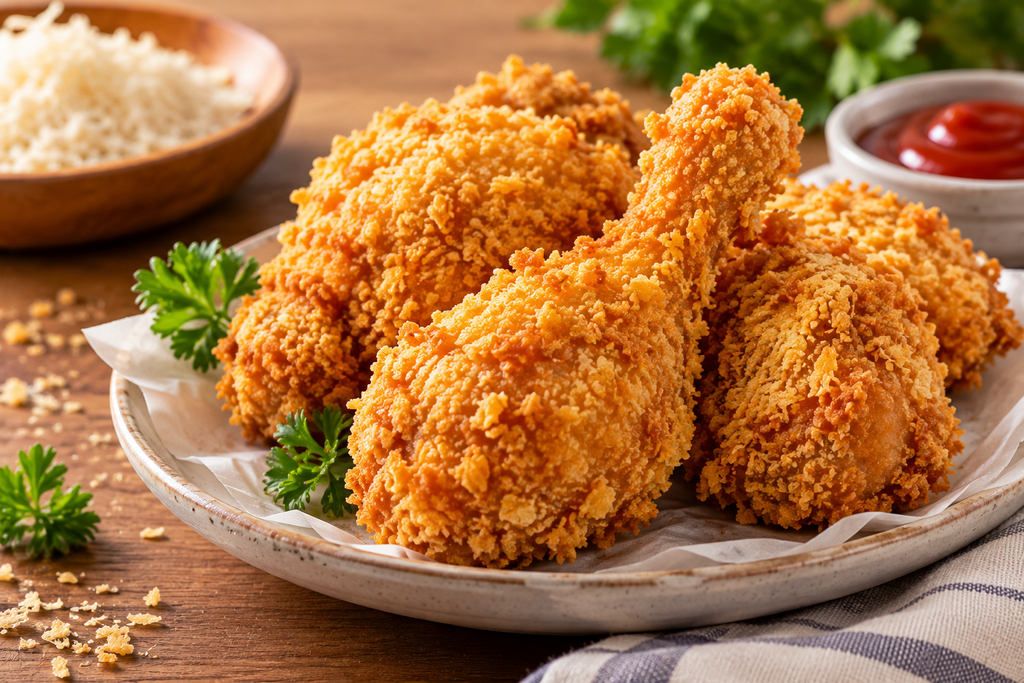
Texture is one of the first things to evaluate when selecting a fried chicken breading.
A fine breadcrumb can create a relatively compact and uniform coating.
Panko, with its larger and more open particle structure, can create a more textured and visually crispy surface.
Snowflake-shaped crumbs can provide another appearance and texture option, particularly when manufacturers want a distinctive crispy coating.
3. Coating Adhesion Is Just as Important as Crispiness
As you known, a crispy coating is not useful if it does not stay attached to the chicken.
Good adhesion usually requires the complete breading system to work together.
A typical process may include:
Chicken → Predust → Batter → Breadcrumb/Panko → Frying
Each stage can influence the final coating.
For example, the chicken surface may have different moisture levels. The batter viscosity may affect coating pickup. The crumb structure can influence how the particles attach to the batter.
This is why selecting breadcrumbs for fried chicken should not be based only on particle size or appearance.
The interaction between the product, batter and dry coating needs to be evaluated.
4. Choose the Right Coating Based on the Chicken Product
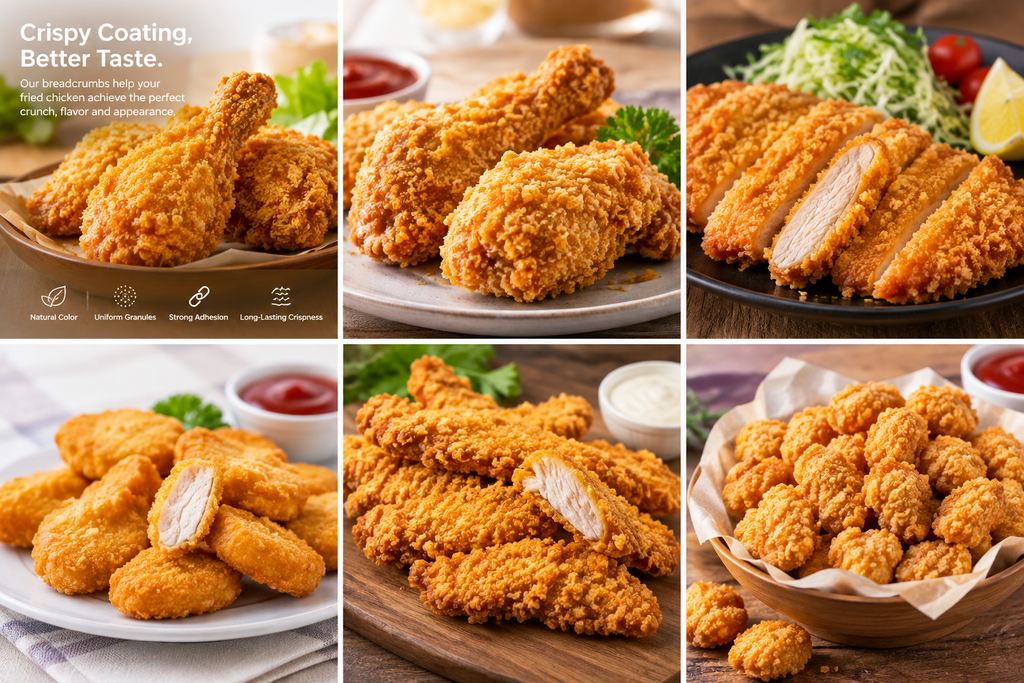
Different chicken products have different coating requirements.
Chicken Tenders
Chicken tenders often require:
- Good coating adhesion
- Consistent coverage
- Crispy texture
- Stable appearance after frying
A suitable breading system may combine a predust or batter with breadcrumbs or panko.
Chicken Cutlets
Chicken cutlets generally have a relatively large surface area.
A coarser crumb or panko can help create a more visible and textured crust.
Chicken Nuggets
Nuggets often require a more controlled and uniform coating.
A finer breadcrumb or formulated chicken breading mix may be more suitable depending on the desired product appearance.
Korean-Style Fried Chicken
Korean-style fried chicken often focuses on a thin, crispy exterior.
The coating system needs to balance adhesion, crispness and surface texture while working with the frying process.
Frozen Fried Chicken
For frozen products, the evaluation should go beyond the fryer.
Manufacturers may need to consider:
Frying → Cooling → Freezing → Storage → Reheating → Final Texture
A coating that performs well immediately after frying may not necessarily provide the same result after freezing and reheating.
This is why frozen chicken products require application testing under actual processing conditions.
5. Particle Structure Matters
When selecting a breadcrumb or panko product, particle structure can have a significant effect on the final coating.
Very fine particles can create a compact surface.
Larger particles can create more visible texture.
Panko flakes can create an open, crunchy appearance.
However, bigger does not always mean better.
If the particle is too large for the product or equipment, coating coverage may become inconsistent.
If the particle is too fine, the finished product may not achieve the desired visual texture.
The objective is to find the right balance between:
Particle structure + coating coverage + adhesion + frying performance
6. Don’t Choose a Fried Chicken Coating Based on Price Alone
For industrial food production, the lowest ingredient price does not necessarily mean the lowest overall cost.
Manufacturers should also consider:
- Coating pickup
- Product yield
- Coating loss
- Frying performance
- Oil consumption
- Production stability
- Finished product appearance
- Rework and waste
- Customer acceptance
A breadcrumbs coating that costs slightly more per kilogram may still provide better overall value if it improves coating pickup, reduces production loss or delivers a more consistent finished product.
For this reason, coating performance should be evaluated together with total production cost.
7. Match the Coating With Your Production Process
A coating that works well in one production environment may behave differently in another.
Important factors include:
- Manual or automated breading
- Batter application method
- Frying temperature
- Frying time
- Fryer type
- Line speed
- Product moisture
- Holding time
- Freezing and reheating conditions
For food manufacturers, a successful food coating solution is not only about the ingredient itself.
It is about how the ingredient performs within the entire production system.
8. Which Coating Should You Choose?
There is no universal answer.
As a starting point:
1.Choose fine breadcrumbs when you need:
A relatively uniform and compact coating.
2.Choose coarse breadcrumbs when you need:
More visible crumb texture.
3.Choose panko when you need:
A light, flaky and crunchy coating appearance.
4.Choose snowflake crumbs when you need:
A distinctive textured coating and visual appeal.
5.Choose a breading or batter mix when you need:
A more controlled coating system with specific functional requirements.
In many commercial applications, the best solution may also be a combination of different coating components rather than a single ingredient.
The Right Fried Chicken Coating Is a System
As a food manufacturer, choosing the right coating should start with the finished product, not simply the ingredient name.
The same breadcrumb can produce different results depending on:
Product + Batter + Coating + Frying Process + Holding Conditions
That is why application testing is an important part of developing a reliable fried chicken coating.
At Guofen Mr., we provide breadcrumbs, panko, snowflake crumbs, breading & batter mixes, and marinades & seasonings for food manufacturers and foodservice applications.
Our approach is not simply to supply an ingredient.
We work with customers to understand their product, processing conditions and desired results, then help develop a suitable food coating solution.
Looking for the right breading for fried chicken?
Contact Guofen Mr. to discuss your product requirements and coating application.Email:[email protected]